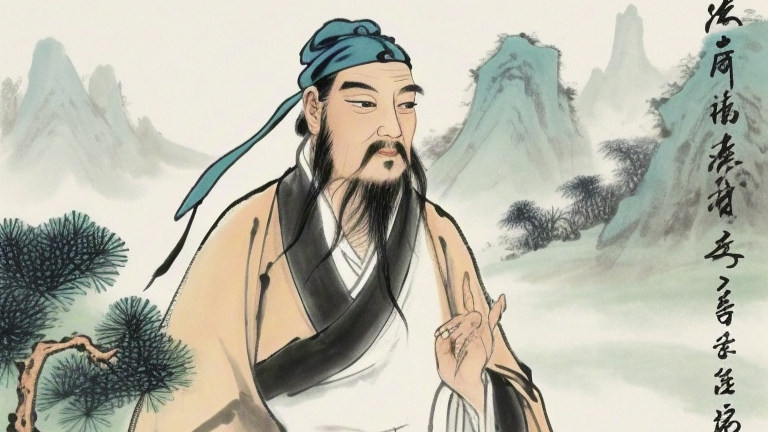
Ge Hong
Introduction
Ge Hong (283–363) was a Chinese Taoist philosopher, alchemist, and author during the Eastern Jin Dynasty (317-420). He is considered one of the most significant figures in Taoist tradition due to his contributions to Chinese alchemy, medicine, and philosophy. Ge Hong is best known for his work "Baopuzi" (The Master Who Embraces Simplicity), which provides insights into Taoism, alchemy, and the quest for immortality.
Early Life and Background
Ge Hong was born into a scholarly family in Jurong, present-day Jiangsu province. His family had a longstanding tradition of Confucian scholarship and public service. However, Ge Hong developed a keen interest in Taoism and alchemy, diverging from his family's Confucian roots. During his lifetime, China was experiencing political instability, which influenced Ge Hong's pursuit of knowledge, particularly in areas that promised spiritual and physical longevity.
Contributions to Alchemy and Medicine
Ge Hong's writings reveal an extensive understanding of alchemical practices and herbal medicine. He was particularly focused on the pursuit of immortality, a common theme in Taoist philosophy. Ge Hong's "Baopuzi" contains detailed instructions on the preparation of elixirs, dietary regimens, and breathing techniques, all aimed at achieving longevity. He also documented numerous herbal remedies and their applications, contributing significantly to Chinese medicine.
"Baopuzi" and Taoist Philosophy
The "Baopuzi" is divided into two parts: the inner chapters, which deal with esoteric subjects like alchemy and immortality, and the outer chapters, which address Confucian ethics and practical governance. Ge Hong's work is notable for its synthesis of Taoist and Confucian ideas, emphasizing a balance between spiritual pursuits and social responsibilities. His writings advocate for simplicity, humility, and the cultivation of inner virtues, reflecting Taoist principles.
Legacy and Influence
Ge Hong's influence extends beyond Taoism, impacting various aspects of Chinese culture and philosophy. His work inspired later generations of alchemists and Taoist practitioners. The "Baopuzi" remains a critical text for understanding Taoist thought and the historical context of alchemical practices in China. Ge Hong's integration of medicinal knowledge with philosophical inquiry laid the groundwork for subsequent developments in traditional Chinese medicine.
Ge Hong's interest in alchemy was primarily driven by the Taoist quest for immortality. In the "Baopuzi", Ge Hong describes various alchemical processes, including the creation of the "Golden Elixir", believed to confer eternal life. His writings detail the use of minerals, metals, and herbs in these alchemical experiments. Ge Hong's approach to alchemy was systematic, combining empirical observation with mystical and spiritual elements.
Ge Hong's contributions to traditional Chinese medicine are significant. He documented various herbal treatments and remedies, many of which are still used in modern practice. His work highlighted the importance of balance and harmony in maintaining health, principles that are central to Chinese medical theory. Ge Hong's integration of alchemical and medical knowledge laid the foundation for future advancements in Chinese medicine.
Philosophical Contributions
Ge Hong's philosophical writings reveal a deep integration of Taoist and Confucian thought. He argued for the compatibility of Taoist spiritual practices with Confucian social ethics. In the "Baopuzi", Ge Hong espoused ideas of simplicity, humility, and non-attachment. His philosophy emphasized balance, both in personal conduct and in the broader social and natural worlds.
Ge Hong's unique philosophical stance was his ability to reconcile the seemingly disparate ideologies of Taoism and Confucianism. He saw Confucianism's focus on social responsibility and Taoism's pursuit of spiritual enlightenment as complementary. Ge Hong advocated for a life that embraces both the duties of Confucian ethics and the spiritual liberation of Taoism, exemplifying a holistic worldview.








